Radio ear-pieces linked to police hearing symptoms
• New research suggests that the radio ear-pieces worn by UK police officers may be harmful to hearing
• The study was led by Dr Hannah Guest and overseen by Professor Chris Plack, both of the University of Manchester
• Findings were published on 30 January 2026, in the peer-reviewed journal Trends In Hearing
Overview
In the UK, most police officers communicate via radio ear-pieces, which are capable of loud sound levels. To reduce risk of hearing damage, officers must routinely choose low volume-control settings.
Until recently, no research had investigated the settings that officers actually use, or their effects on hearing. The Airwave Hearing Study was designed to correct this gap in knowledge.
The research involved 4,498 police personnel, who completed a survey on ear-piece use and hearing health. They gave detailed information on their volume-control settings, patterns of ear-piece use, immediate after-effects, and potential long-term hearing symptoms: tinnitus (ringing ears) and diagnosed hearing loss.

1. Estimated noise exposure from ear-pieces exceeds recommended levels
85 dBA is an important trigger point in UK workplace noise regulations. If workers’ average noise exposure exceeds this level, employers must usually take steps to reduce it.
For around 75% of the ear-piece users in our study, average noise exposure from the ear-piece exceeded 85 dBA.
Our calculations of noise exposure only took account of ear-piece noise (other types of noise weren’t measured). For most police, total noise exposure will be even higher, adding to their overall risk of hearing damage.
2. Ear-piece use can lead to signs of temporary hearing loss
People often have temporary hearing loss after being in very loud places, like noisy concerts or nightclubs. They typically experience muffled hearing, tinnitus (ringing ears), or both. It usually subsides after minutes or hours.
However, it’s a useful warning sign that an environment is too loud, and potentially damaging to long-term hearing health.
We wanted to know if police officers ever experienced these warning signs after wearing an ear-piece.
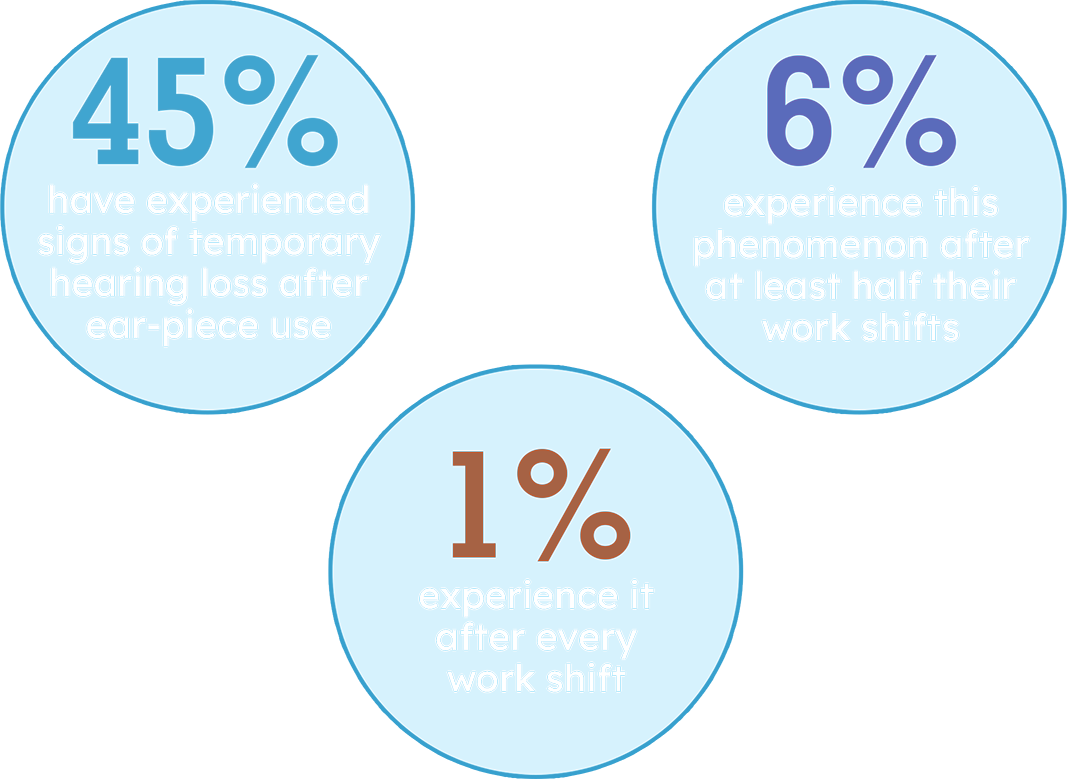
3. Ear-piece use with temporary hearing loss leads to increased risk of tinnitus
“Tinnitus” means sounds in your ears that don’t come from the world around you (often ringing or whistling).
As mentioned above, many people get temporary tinnitus after noise exposure. It’s also common to experience “short-lasting spontaneous tinnitus”, which happens without any apparent immediate cause and fades away within 5 minutes. Neither of these are considered signs of permanent hearing damage, and they wouldn’t lead to a person being diagnosed as “having tinnitus”.
Instead, the most important kind of tinnitus is “prolonged spontaneous tinnitus”, which has no apparent immediate cause and lasts for over 5 minutes. This is what we mean when we say someone “has tinnitus”. For many people, it is frequent or constant, and it is generally permanent. Some people are distressed by it, some aren’t.
4. Tinnitus is more common in the exposed ear than in the opposite ear


5. Links between ear-piece use and hearing loss show the same pattern as for tinnitus
Survey respondents told us whether they had any diagnosed hearing loss (diagnosed by a professional using “pure tone audiometry”, which is the standard hearing test used by NHS audiologists and private hearing-aid clinics).
If they answered yes, then they were asked if they had similar hearing in both ears, better hearing in their right ear, or better hearing in their left ear.
6. Police tend to report pooring hearing in the exposed ear than in the opposite ear


Further information
Full details of the research are published in the peer-reviewed journal Trends In Hearing: https://doi.org/10.1177/23312165251410988
Researchers and other professionals who require further information on the study may email the lead author Dr Hannah Guest at noise@manchester.ac.uk.
Please note that questions from private individuals about their hearing health will not receive a response.
For media enquiries, contact Mike Addelman (Media Relations Officer, 07717 881567, michael.addelman@manchester.ac.uk).